
Nobody enjoys reading insurance paperwork. That is exactly why so many people discover the most expensive insurance mistakes at the worst possible time: after a car accident, a burst pipe or a hospital stay, when the claim is rejected or the payout is far smaller than expected. The policy was in the drawer the whole time. The details just were not read.
The encouraging part is that most costly errors are predictable and easy to avoid once you know what to look for. This guide covers the ten mistakes we see most often, explains how the claim process really works and gives you a simple checklist for reviewing any policy. It is general education, not personal advice, and rules vary by country and insurer, so always check your own policy wording.
In this article
- Why Insurance Mistakes Are So Expensive
- Mistake 1: Buying Only on Price
- Mistake 2: Not Reading the Exclusions
- Mistake 3: Being Underinsured
- Mistake 4: Giving Incorrect or Incomplete Information
- Mistake 5: Choosing the Wrong Excess
- Mistake 6: Letting Policies Auto-Renew Without Checking
- Mistake 7: Skipping Life or Income Protection
- Mistake 8: Ignoring Health Insurance Details
- Mistake 9: Failing to Document Everything
- Mistake 10: Mishandling the Claim Process
- The Insurance Claim Process in 8 Steps
- How Technology Is Changing Insurance (And What It Means for You)
- A Five-Minute Policy Review Checklist
- Frequently Asked Questions
- Final Thoughts
Why Insurance Mistakes Are So Expensive
Insurance is a promise that is tested only when something goes wrong. Until then, two policies that look similar on a comparison website can behave very differently. One may cover water damage from a leaking pipe, while the other excludes it. One may pay the full replacement cost of a stolen laptop, while the other deducts for age.
Mistakes tend to fall into three groups: buying the wrong cover, handling the policy badly while you hold it and mishandling the claim itself. Let us go through each.
Mistake 1: Buying Only on Price
The cheapest premium is tempting, especially when budgets are tight. But a low price often hides a high excess (deductible), lower limits, narrow cover or exclusions that only appear in the fine print. Saving a small amount a month is not worth it if a claim then costs you thousands out of pocket.
Compare policies on four things together: what is covered, what is excluded, how much you pay before the insurer pays (the excess) and the maximum the insurer will pay. Then look at price. A comparison table is the easiest way to do it:
| Compare | Policy A | Policy B |
|---|---|---|
| Annual premium | Lower | Higher |
| Excess per claim | High | Moderate |
| Key exclusions | Several, including water damage | Few |
| Claim limit | Lower | Higher |
| Real cost if you claim | Often higher | Often lower |
Mistake 2: Not Reading the Exclusions
Every policy lists what it will not pay for. Common examples include wear and tear, gradual damage, damage while unoccupied for long periods, using a vehicle for business without declaring it, and certain pre-existing medical conditions. The headline benefits are in the brochure, but the exclusions decide your claim.
Before you buy, read the “what is not covered” section from beginning to end. If something is unclear, ask the insurer or broker to explain it in writing. A reputable provider will not mind the question.
Mistake 3: Being Underinsured
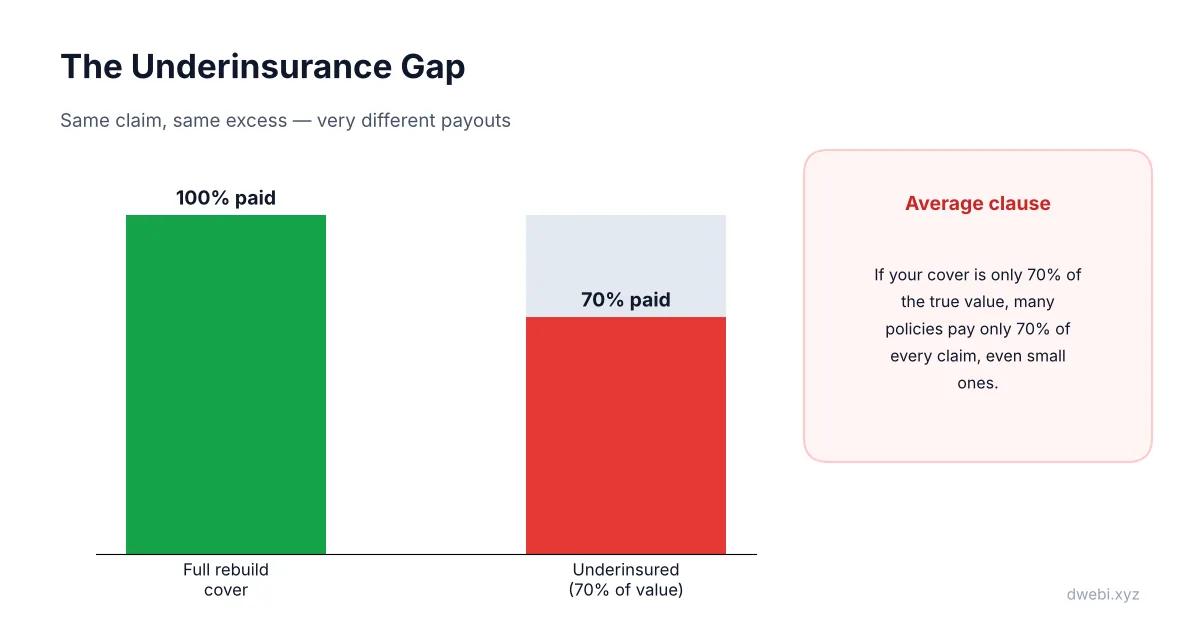
Underinsurance means your cover limit is lower than the real cost of replacement. It is especially common with home and contents policies. People insure a house for its market price, but cover should reflect the cost of rebuilding, which can be quite different. Many policies also have “average” clauses that reduce every payout proportionally if you are underinsured, even for a small claim.
- Recalculate your rebuild cost every year or two, since building costs change.
- Make a simple home inventory with photos and receipts for valuable items.
- Check single-item limits for jewellery, laptops, bikes and musical instruments, and add specified cover where needed.
Mistake 4: Giving Incorrect or Incomplete Information
This one can void a policy completely. When you apply, the insurer relies on your answers: your age, address, driving history, health, the use of the property and previous claims. If something is wrong, even by accident, they may reduce a payout or cancel cover. Insurers often check details at claim time, which is when you least want a surprise.
Answer every question honestly and fully. If your circumstances change during the year, for example you start working from home, rent out a room or modify your car, tell your insurer promptly and ask whether it changes your cover.
Mistake 5: Choosing the Wrong Excess
A higher excess lowers your premium, which is attractive. But if you choose an amount you cannot comfortably pay, you may avoid making small claims, or struggle when a real one arrives. Pick an excess that matches your emergency savings. If you do not yet have a safety fund, build one first; our step-by-step guide to building an emergency fund shows how, and it makes a higher excess much easier to live with.
Mistake 6: Letting Policies Auto-Renew Without Checking
Many insurers offer their best prices to new customers and quietly increase them for loyal ones. If you renew automatically every year without comparing, you may be paying more than you need to for the same cover. Diarise your renewal dates, request quotes about three to four weeks ahead and compare like-for-like. Before switching, make sure there is no gap in cover and that the new policy includes everything you currently rely on.
Mistake 7: Skipping Life or Income Protection
Insuring a phone but not your ability to earn an income is a common imbalance. If someone depends on your salary, such as a partner, children or parents, life insurance and income protection deserve serious thought. Term life insurance, which covers a fixed number of years, is often far cheaper than people assume when bought young and healthy.
As a rule of thumb, work out how much money your dependants would need to cover debts, living costs and future goals, then compare that with any cover you already have through work. Do not forget to name the right beneficiaries and update them after life events like marriage or a new child. This fits naturally into a wider personal finance plan, where insurance is the step that protects all the others.
Mistake 8: Ignoring Health Insurance Details
Health policies are full of terms that surprise people: waiting periods, annual limits, network restrictions, co-payments and exclusions for pre-existing conditions. Always check whether your preferred hospitals and doctors are in the insurer’s network, what the annual and per-treatment limits are, and whether you need pre-authorisation for procedures. Ask what happens if you need treatment abroad. In some places, public systems cover the basics and private insurance fills the gaps, so understand which role your policy plays.
Mistake 9: Failing to Document Everything
When you make a claim, the insurer decides based on evidence. Without receipts, photos, serial numbers or a police report, proving what you owned or what happened becomes difficult. Spend an afternoon now, not after a loss.
- Photograph or film each room and valuables, and store copies in cloud storage, not only on your phone.
- Keep receipts and warranties for expensive items.
- Store your policy documents, the insurer’s claims phone number and your policy number somewhere you can reach even if your home is unusable.
Keep those digital copies secure with strong passwords and two-factor authentication. Our guide to protecting your online accounts explains how.
Mistake 10: Mishandling the Claim Process
Even a perfect policy can be undermined by mistakes at claim time: waiting too long to report, throwing away damaged items too soon or accepting the first offer without reading it. Knowing the usual steps helps you stay in control.
Three real-style examples of how mistakes play out
These are simplified scenarios, but they reflect patterns that consumer organisations and claims handlers describe again and again.
- The unlisted laptop. A freelancer assumes the home contents policy covers the laptop she uses for work. After a burglary, the insurer points to the business-use exclusion. Lesson: tell your insurer how you use items, and ask about business cover or a specific add-on.
- The old-for-old payout. A family’s washing machine is destroyed by a flood. Their policy pays the depreciated value, not the price of a new one, leaving a gap of several hundred. Lesson: check whether your policy is “new for old” or pays market value.
- The late phone call. A driver waits two weeks to report a minor collision because the damage looks small. The other party then makes an injury claim, and the insurer cites late notification. Lesson: report incidents quickly, even if you think you will not claim.
In each case the policy existed and the premiums were paid. What was missing was a short conversation with the insurer before the event. Spending ten minutes on the phone asking “would this situation be covered?” is one of the cheapest forms of protection there is, and it creates a record in case of dispute. Ask for the answer by email so you have it in writing.
Questions worth asking before you buy any policy
- What are the three most common reasons claims are refused on this type of policy?
- Is there a cooling-off period if I change my mind, and what do I get back?
- How are claims paid: repair, replacement, cash or a voucher?
- Is there any limit on the total I can claim in a year?
- What happens to my premium if I make a claim?
The Insurance Claim Process in 8 Steps
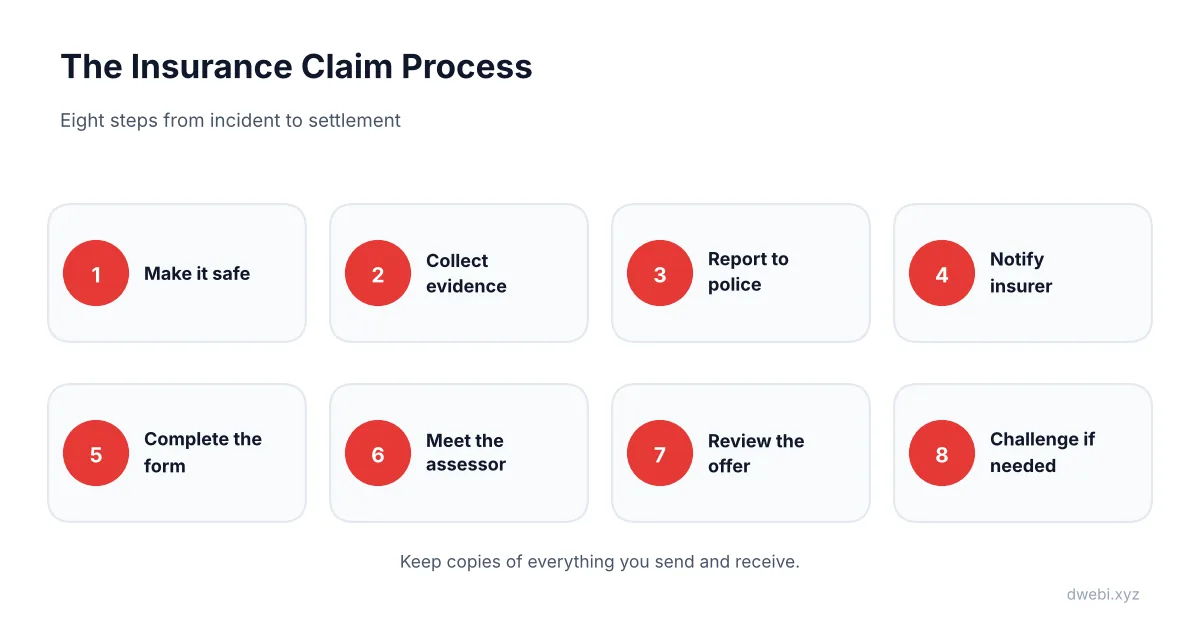
Details differ between countries and insurers, but a typical claim follows this pattern:
- Make things safe. Prevent further damage where you can, for example by turning off the water or moving belongings. Call emergency services if anyone is hurt.
- Collect evidence. Take photos and videos of the damage, and gather names and contact details of witnesses or other parties involved.
- Report the incident. Report theft or serious accidents to the police and get a reference number.
- Notify your insurer promptly. Many policies set deadlines. Ask for a claim reference number and confirm the next steps.
- Complete the claim form honestly. Provide accurate details and attach receipts, quotes and photos. Keep copies of everything you submit.
- Cooperate with the assessor. An adjuster may inspect the damage or ask questions. Be polite, factual and keep a note of what was said.
- Review the settlement offer. Check that it matches your cover, excess and the real cost of repairs or replacement. You can ask for the calculation in writing.
- Challenge if necessary. If the claim is declined or underpaid, ask for the reason in writing, point to the relevant policy wording and use the insurer’s complaints procedure.
If the complaint is not resolved, most countries have an independent body you can go to, such as a financial ombudsman or insurance regulator. In the United States, the National Association of Insurance Commissioners helps consumers find their state regulator, and the Insurance Information Institute publishes plain-language guides on cover types and claims. Wherever you live, search for your own national regulator and keep its contact details with your policy documents.
How Technology Is Changing Insurance (And What It Means for You)
Insurers increasingly use automation: apps for filing a claim with photos, systems that estimate vehicle damage and pricing models that use large amounts of data. This can mean quicker payouts for simple claims. It also means you should understand what data you are sharing, particularly with devices that track driving or home activity, and double-check automated decisions that look wrong. If you want to understand how these systems work, our article on data science vs artificial intelligence is a friendly introduction.
The property side is changing as well. Smart sensors that detect leaks or smoke can reduce risk and sometimes lower premiums, a trend we discuss in our guide to real estate technology. Beware of one thing, though: scammers also impersonate insurers and claim handlers. Never pay a “release fee” to get a payout, and verify any unexpected message by calling the number on your policy documents, not the one in the message. The same checking habits from our guide to the reliability of online information apply here.
A Five-Minute Policy Review Checklist
- Do I know what is excluded, and have I read it myself?
- Is the cover limit high enough to replace what I own or rebuild my home?
- Can I afford the excess tomorrow without borrowing?
- Is every detail I gave the insurer still correct?
- When does the policy renew, and have I compared prices?
- Do I know who to call, and is my claim documentation stored safely?
- Do people who depend on me have life or income protection?
Frequently Asked Questions
What is the most common insurance mistake?
Buying purely on price and not reading the exclusions is probably the most common. A cheap policy that does not cover the event you are worried about gives you very little for your money.
Can an insurer refuse my claim?
Yes, if the event is excluded, the policy was not active, information was misrepresented or conditions were not met. If you believe the refusal is wrong, ask for the reason in writing and use the insurer’s complaints process, then an independent ombudsman or regulator if needed.
How long do I have to make a claim?
It depends on the policy and the country, but you should report an incident as soon as possible. Many policies require prompt notification, and delay can weaken your claim.
Should I always make a small claim?
Not necessarily. Consider your excess, the possible effect on future premiums and how the insurer records claims. Ask your insurer or broker before deciding, and avoid making any claim that is not genuine.
Final Thoughts
Avoiding the biggest insurance mistakes does not take expert knowledge. It takes about an hour of honest reading, a habit of reviewing policies once a year and a folder of evidence that you hope never to use. Read the exclusions, insure for real replacement cost, tell the truth, document your belongings and learn the claim steps before you need them.
Start tonight with one policy: open the document, find the exclusions and the excess, and write down the two things that surprise you. Those two notes are probably the cheapest insurance advice you will ever get.



Leave a Reply