
Most people do not have a money problem so much as a missing plan. They earn, they spend, they hope there is something left at the end of the month, and they quietly worry about it. A personal finance plan replaces that vague worry with a few clear decisions: where your money goes, what you are saving for, how you handle debt and how you protect yourself when life goes sideways.
You do not need a high income, a finance degree or an expensive adviser to build one. You need a few hours, honest numbers and a willingness to keep things simple. This guide breaks the process into nine practical steps, with examples you can copy and adapt to your own currency and country.
In this article
- What Is a Personal Finance Plan (and Why Does It Work)?
- Step 1: Find Out Where You Stand Today
- Step 2: Set Clear Goals With Deadlines
- Step 3: Build a Budget You Can Actually Follow
- Step 4: Build an Emergency Fund First
- Step 5: Deal With Debt Strategically
- Step 6: Protect Yourself With the Right Insurance
- Step 7: Start Investing for the Long Term
- Step 8: Automate Everything You Can
- Step 9: Review Your Plan Regularly
- A Sample Personal Finance Plan on One Page
- Common Personal Finance Mistakes to Avoid
- Frequently Asked Questions
- Final Thoughts
What Is a Personal Finance Plan (and Why Does It Work)?
A personal finance plan is a written set of goals and rules for your money. It usually covers income, spending, savings, debt, insurance and investing. The point is not to track every cent forever. The point is to make the big decisions once, in a calm moment, so that daily choices become easier.
People who write goals down and automate their saving tend to do better than people who rely on willpower at the end of the month. Willpower runs out; systems do not. Think of your plan as a small, boring machine that quietly pushes you in the right direction.
Step 1: Find Out Where You Stand Today
Before you can plan, you need a starting point. Spend an hour gathering three things:
- Your monthly income after tax, including irregular income averaged over the last six months.
- Your actual spending, taken from bank and card statements rather than memory. Most people underestimate small, repeated purchases.
- Your net worth: everything you own (savings, investments, property) minus everything you owe (loans, cards, other debts).
Do not judge the numbers. Net worth that starts negative is common, especially for younger people with student or vehicle loans. The goal of this first step is clarity, and clarity alone often reduces stress.
Step 2: Set Clear Goals With Deadlines
“Save more” is a wish, not a goal. A useful goal has an amount, a date and a reason. Split your goals into three horizons:
- Short term (under 1 year): build a starter emergency fund, clear a small card balance, pay for a planned trip.
- Medium term (1 to 5 years): save for a deposit, a wedding, a course or a vehicle.
- Long term (5+ years): retirement, children’s education, financial independence.
Write each goal like this: “Save 3,000 for an emergency fund by June, which is 250 per month.” Now it is something you can track and automate.
Step 3: Build a Budget You Can Actually Follow
A budget is simply a plan for your income, and the best budget is the one you will stick with. Two popular approaches work for most people.
The 50/30/20 method
Popularised by U.S. senator and former Harvard professor Elizabeth Warren, this rule divides after-tax income into needs (50%), wants (30%) and savings or debt repayment (20%). It is a starting guide, not a law. In an expensive city, needs may take 60% or more, and that is fine as long as you are honest about it and still save something.

The zero-based budget
Here, every unit of income is assigned a job until nothing is left unallocated. It takes more effort, but it works well for people with irregular spending or tight incomes. Whichever method you choose, review it monthly for the first three months and adjust to reality.
| Category | Example (income 3,000) | Share |
|---|---|---|
| Needs: rent, food, bills, transport | 1,500 | 50% |
| Wants: dining out, entertainment, hobbies | 900 | 30% |
| Savings and extra debt payments | 600 | 20% |
If your wants feel impossible to trim, look first at subscriptions, food delivery and impulse purchases. Cancelling five unused subscriptions often frees more money than skipping a daily coffee.
Step 4: Build an Emergency Fund First
An emergency fund is the foundation under every other part of the plan. Without it, one car repair or medical bill goes on a credit card and sets you back for months. A common guideline is to hold three to six months of essential expenses in an easily accessible savings account, although people with unstable income may want more.
If that sounds far away, start with a mini target such as one month of essentials, then keep going. We cover this in detail, with a month-by-month example, in our guide to building an emergency fund from scratch.
Step 5: Deal With Debt Strategically
Not all debt is equal. A fixed-rate home loan at a modest rate is very different from a credit card charging around 20% a year. Start by listing every debt with its balance, interest rate and minimum payment. Then pick one of two proven strategies:
- Avalanche: pay minimums on everything and put extra money on the debt with the highest interest rate first. This saves the most money.
- Snowball: put extra money on the smallest balance first. It may cost slightly more in interest, but quick wins keep many people motivated.
Here is why speed matters. Imagine a 5,000 card balance at 20% annual interest. Paying 200 a month takes about 33 months and costs roughly 1,500 in interest. Paying 400 a month clears it in about 15 months and costs around 650 in interest. Doubling the payment cuts the time by more than half and saves over 800. Check with your lender whether early repayment carries any fees before you accelerate.
Step 6: Protect Yourself With the Right Insurance
Insurance is the part of a financial plan that people skip until it is too late. A serious accident, illness or house fire can wipe out years of saving. At a minimum, review:
- Health cover suitable for your country and family.
- Life or income protection if anyone depends on your income.
- Home or contents and motor cover for the assets you own.
Compare policies on what they actually cover, not just the price. Our list of costly insurance mistakes to avoid shows the traps that most often leave people underinsured.
Step 7: Start Investing for the Long Term
Savings protect you from short-term shocks. Investing is how money grows faster than inflation over decades. The key idea is compound growth: returns earn their own returns, so time matters more than cleverness.
The table below shows what saving 200 per month could grow to at different hypothetical average annual returns. These are illustrations, not predictions, and real markets rise and fall along the way.
| Years | Total you pay in | At 4% a year | At 6% a year | At 8% a year |
|---|---|---|---|---|
| 10 | 24,000 | 29,450 | 32,776 | 36,589 |
| 20 | 48,000 | 73,355 | 92,408 | 117,804 |
| 30 | 72,000 | 138,810 | 200,903 | 298,072 |
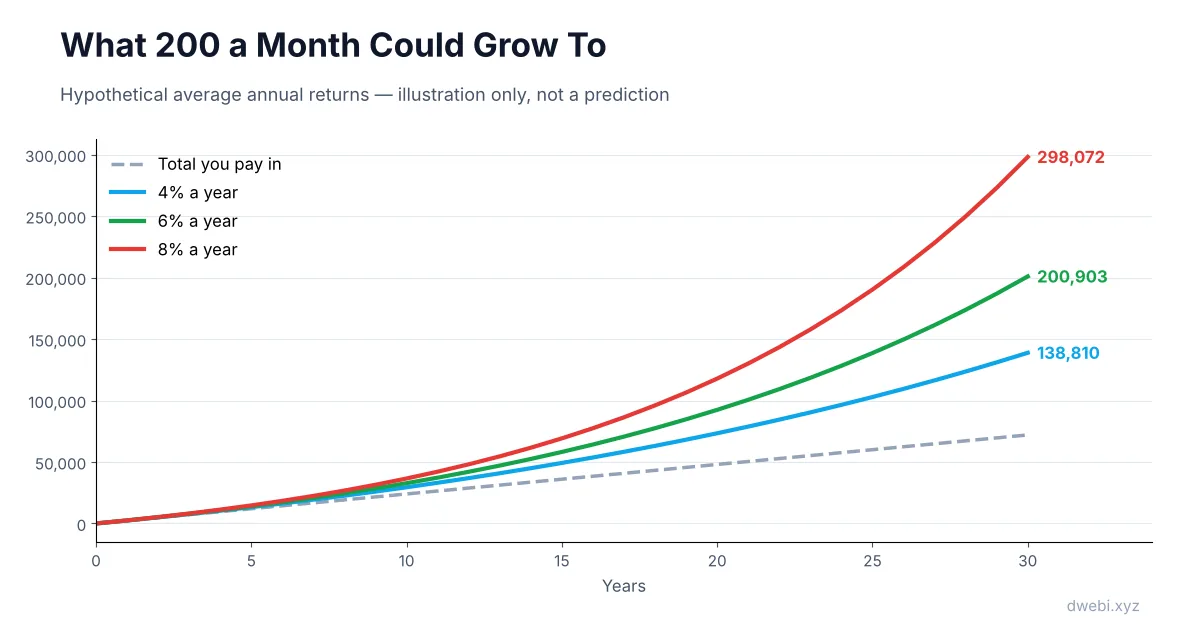
Look at the 30-year row: at 6%, the growth is more than the total you contributed. The earlier you start, the more work compounding does for you.
Simple principles for beginner investors
- Diversify. Low-cost index funds spread your money across hundreds or thousands of companies, reducing the damage if one fails.
- Watch fees. A one percent annual fee sounds small but can consume a large slice of your returns over 30 years.
- Match risk to time. Money you need within five years usually should not sit in volatile investments.
- Ignore hot tips. If a stranger promises guaranteed high returns, assume it is a scam. Investor education sites such as Investor.gov and the Consumer Financial Protection Bureau’s tools explain how to check an investment and avoid fraud.
Rules about retirement accounts, taxes and available products depend on your country, so check local regulations or speak to a licensed adviser. If you are considering property as part of your plan, read about real estate technology and property investment first and compare it with simpler options such as index funds.
Step 8: Automate Everything You Can
Automation is the cheat code of personal finance. On the day your salary arrives, have your bank automatically move money to your emergency fund, extra debt payments and investments before you can spend it. What is left is yours to enjoy, guilt-free.
- Set standing orders for savings and investment contributions.
- Use automatic payments for at least the minimum on every debt to avoid late fees.
- Increase your savings amount whenever your income rises, so lifestyle creep does not swallow every raise.
Secure the accounts that hold all this money. Use strong, unique passwords and two-factor authentication on every banking and investing app. Our guide to protecting your online accounts shows how to set that up in under an hour.
Step 9: Review Your Plan Regularly
A plan that never changes will eventually stop fitting your life. Schedule a short money check-in once a month and a deeper review once a year. In the monthly check, compare spending with your budget and make sure automatic transfers still work. In the yearly review, update your net worth, reset goals, re-shop your insurance and rebalance your investments.
Also review after major life events: a new job, marriage, a baby, moving house or losing a source of income. These moments change your goals and your risks, so your plan should change too.
A Sample Personal Finance Plan on One Page
To make this concrete, here is what a simple personal finance plan might look like for someone earning 3,000 a month after tax, with a small credit card balance and no savings yet. Your numbers will differ, but the structure travels well.
| Priority | Action | Monthly amount | Target |
|---|---|---|---|
| 1 | Starter emergency fund | 200 | 1 month of essentials in about 8 months |
| 2 | Card balance (avalanche) | 300 | Debt-free in about 17 months |
| 3 | Insurance review | Part of needs | Done this quarter |
| 4 | Long-term investing | 100, rising later | Start now, increase after the card is cleared |
Once the card is paid off, the 300 previously used for debt moves to investing and the full emergency fund. That “rolling” of freed-up money is how people make steady progress without feeling like they are earning more. It is simply the same income, redirected.
Adjusting the plan for irregular income
Freelancers, drivers and small business owners often have uneven months. If that is you, calculate your lowest typical month and build the budget around it. In better months, send the extra to a separate buffer account first, then to goals. A bigger emergency fund, closer to six months or more of essentials, is sensible when income is unpredictable.
Making your plan work as a couple or family
Money is one of the most common sources of arguments in relationships, and a plan works far better when everyone has helped shape it. Hold a monthly “money date” with snacks and no phones, agree on shared goals first and then on individual spending money that nobody has to justify. Open conversations about debts and fears early. A written plan turns an emotional topic into a practical one.
If children are involved, include them at an age-appropriate level. Letting a ten-year-old manage a small allowance with three jars for spending, saving and giving teaches more than any lecture. Habits formed early often last for life, and your plan becomes a family habit rather than a private chore.
Common Personal Finance Mistakes to Avoid
- Investing before building a safety net. A forced sale during a downturn turns a temporary loss into a permanent one.
- Ignoring small, regular spending. Subscriptions and delivery fees add up quietly.
- Comparing yourself with other people’s online lives. Social media shows spending, not debt.
- Waiting for the perfect moment. Starting with a small amount today beats starting with a bigger amount in three years.
- Making the plan too strict. If your budget leaves no room for enjoyment, you will abandon it. Build in a small amount of fun money.
Frequently Asked Questions
How do I start a personal finance plan with a low income?
Begin with tracking your spending for one month, then set one small automatic saving, even if it is a tiny amount. Focus on building a starter emergency fund, avoid high-interest debt and increase your savings whenever your income grows. Consistency matters more than size.
How much of my income should I save?
Many guides suggest around 20%, but any amount is better than none. If 20% is unrealistic right now, start with 5% and raise it every few months.
Should I pay off debt or invest first?
If your debt carries a high interest rate, such as credit cards, paying it off usually gives a better guaranteed return than most investments. For low-interest debt, it can make sense to do both. If your employer offers a retirement contribution match, taking it is usually worth doing first.
Do I need a financial adviser?
Not always. Many people manage a basic plan on their own. An independent, licensed adviser who charges a transparent fee can help with complex situations such as business ownership, large inheritances or cross-border taxes.
Final Thoughts
A strong personal finance plan is not about extreme frugality or complicated products. It is about knowing your numbers, setting goals, protecting yourself, clearing expensive debt and letting time and automation do the heavy lifting. Nobody builds all nine steps in a weekend, and nobody needs to.
Pick one step you can complete this week. Open a separate savings account, list your debts or cancel a subscription you forgot about. Small actions repeated every month are what change a financial future. I am not a licensed financial adviser, and this article is general education, so check your local rules or speak to a professional before making major decisions.


Leave a Reply