
Ask ten people at a tech meetup to explain data science vs artificial intelligence and you will probably get ten different answers. Job adverts use the terms interchangeably, news headlines blur them, and even some companies selling “AI-powered” software are really doing ordinary statistics. If you are choosing a career, hiring for a team or just trying to follow the news, the confusion is genuinely costly.
The short version is this: data science is about finding answers and insight in data, while artificial intelligence is about building systems that behave intelligently. They overlap heavily, especially through machine learning, but they are not the same thing. This guide explains seven clear differences, shows where the two fields meet and helps you decide which path or tool fits your goals.
In this article
- What Is Data Science?
- What Is Artificial Intelligence?
- Difference 1: The Main Goal
- Difference 2: Scope and Relationship
- Difference 3: Typical Outputs
- Difference 4: Skills and Tools
- Difference 5: How They Use Data
- Difference 6: Careers and Salaries
- Difference 7: Risks, Ethics and Responsibility
- How Machine Learning Connects the Two Fields
- Real-World Examples: Where Each One Shines
- Which One Should You Learn First?
- Common Myths About Data Science and AI
- Frequently Asked Questions
- Final Thoughts
What Is Data Science?
Data science is a field that combines statistics, programming and domain knowledge to extract useful conclusions from data. A data scientist might study why customers cancel a subscription, forecast next quarter’s sales or test whether a new website design really increases sign-ups.
The typical work cycle looks like this: define a question, collect and clean data, explore it, build models or run tests, and then communicate the results so that people can make a decision. The end product is often a report, a dashboard, a forecast or a recommendation. Notice how much of that process involves human judgment and explanation.
What Is Artificial Intelligence?
Artificial intelligence is the broader goal of creating machines that can perform tasks that normally require human intelligence: recognising speech, understanding language, translating, planning, playing games or driving a vehicle. AI is an umbrella term that includes several approaches.
- Rule-based systems: hand-written logic such as “if the temperature is above X, switch on the fan”.
- Machine learning (ML): systems that learn patterns from examples instead of following only fixed rules.
- Deep learning: a branch of machine learning that uses many-layered neural networks and powers most modern image, speech and language systems.
- Generative AI: models that create new text, images, audio or code from prompts.
Where data science usually ends with a human reading a result, AI usually ends with a system that acts: it recommends a video, flags a payment, answers a question or steers a robot.
Difference 1: The Main Goal
A data scientist asks, “What is happening, and why?” An AI engineer asks, “Can we build a system that does this task automatically?” The first goal is understanding and decision support. The second is automation and capability.
Example: a retailer’s data scientist analyses sales history to learn that demand jumps before holidays. An AI team builds a system that automatically adjusts stock orders every day based on predicted demand. The first produces insight, the second produces an automated action.
Difference 2: Scope and Relationship
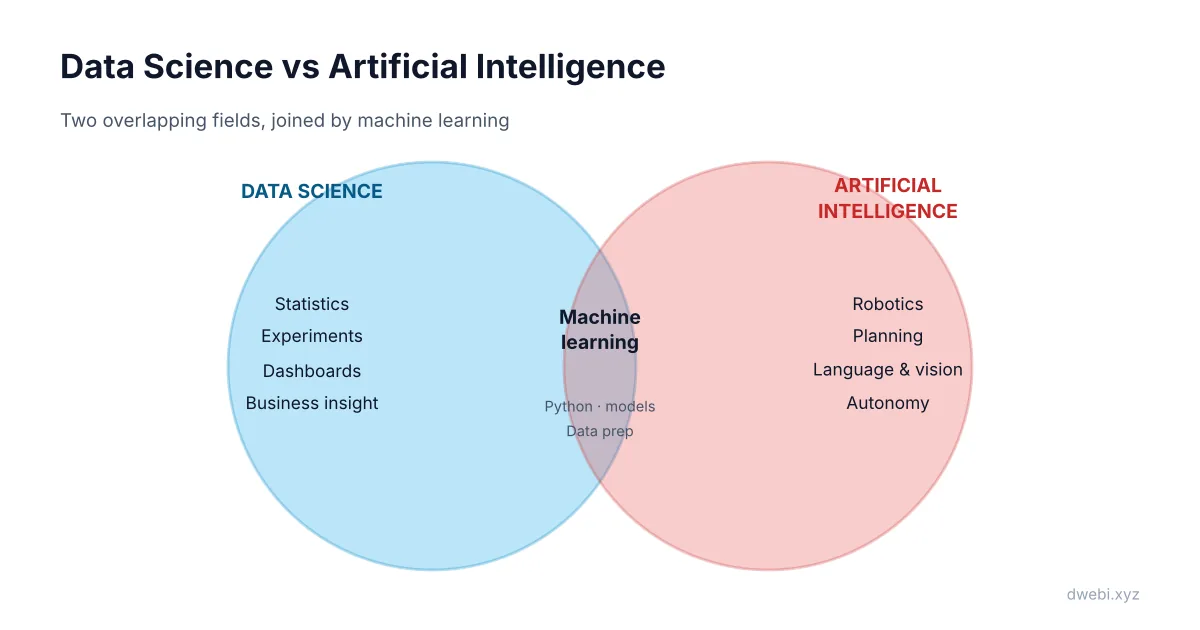
The two fields overlap in a large middle zone, which is machine learning. Many data scientists use machine learning models, and most AI systems today rely on data. But each also has territory the other does not:
- Data science includes statistics, experiments, data visualisation and business analytics that are not AI at all.
- AI includes robotics, search and planning algorithms, computer vision hardware and knowledge systems that are not primarily about analysing datasets.
So neither is simply a subset of the other. A better picture is two circles that intersect, which is exactly how the diagram above shows them.
Difference 3: Typical Outputs
This is the easiest difference to spot in practice. Compare the usual deliverables:
| Aspect | Data science | Artificial intelligence |
|---|---|---|
| Main goal | Insight and decisions from data | Systems that perform intelligent tasks |
| Typical output | Reports, dashboards, forecasts, experiments | Models and products: chatbots, recommenders, vision systems |
| Who uses the result | People making decisions | Users, software or machines acting automatically |
| Core skills | Statistics, SQL, Python or R, storytelling | Machine learning, deep learning, software engineering, maths |
| Data needs | Often modest, structured data | Frequently very large, including text, images and audio |
| Success measure | Quality of the insight and decision | Accuracy, reliability and performance of the system |
Difference 4: Skills and Tools
Both fields use Python heavily, but the emphasis differs. Data scientists spend much of their time with SQL, spreadsheets, data cleaning libraries and statistical methods. They need to explain findings clearly to people who are not technical. Popular tools include Python libraries for analysis, notebooks and visualisation software.
AI engineers lean more towards software engineering, optimisation and deep learning frameworks. They work with libraries such as PyTorch and TensorFlow, and they care about deployment, speed and monitoring in production. For classic machine learning on tabular data, the widely used scikit-learn library sits comfortably in both worlds.
In the middle you will also meet the machine learning engineer, who takes models built by researchers or data scientists and turns them into reliable products. Job titles vary between companies, so always read the responsibilities, not just the title.
Difference 5: How They Use Data
Data scientists are often detectives. They explore a dataset, question where it came from, check for bias and missing values and test hypotheses. A large share of the work, frequently quoted as the majority of project time, goes into preparing and understanding data.
AI systems are more like students. They learn from data during training, then apply what they learned to new situations. The quality and fairness of the training data therefore shape everything the system does. If a hiring model learns from historical decisions that were biased, it may repeat the bias at scale. This is why both fields care about data quality, but AI adds extra concern about how a trained model behaves when no human is checking each output.
That connects to a skill everyone needs when working with AI tools: checking claims and sources. Our guide on the reliability of online information explains how to verify what chatbots and websites tell you.
Difference 6: Careers and Salaries
Career paths in the two areas overlap, but the entry points differ.
- Data analyst: the most common starting role. You query data, build reports and answer business questions with SQL and spreadsheets.
- Data scientist: adds statistical modelling, experimentation and machine learning to the analyst skill set.
- Machine learning engineer: builds, deploys and maintains models in production systems.
- AI researcher or applied scientist: develops new methods, usually with advanced degrees in maths, computer science or a related field.
Pay depends heavily on country, company size and experience, and published salary figures vary a lot between sources. Rather than relying on one number, check current listings in your target market and compare several job boards. Because pay and demand change quickly in this field, focus on building skills that are transferable: SQL, Python, statistics and the ability to explain your work.
Difference 7: Risks, Ethics and Responsibility
Both fields deal with sensitive information, but AI raises additional questions because systems can act on their own. Key concerns include:
- Bias and fairness: models trained on skewed data can disadvantage groups of people.
- Privacy: personal data must be collected and used lawfully, with regulations such as the EU’s GDPR setting strict requirements in Europe.
- Transparency: some deep learning models are hard to explain, which is a problem in areas like lending or healthcare.
- Reliability: generative models can produce confident but false statements, so outputs need checking.
The U.S. National Institute of Standards and Technology publishes its AI Risk Management Framework, a free, practical resource for organisations that want to manage these risks responsibly. As a beginner, the habit to build early is simple: always ask where the data came from and who might be harmed by a wrong answer.
How Machine Learning Connects the Two Fields
If you remember only one idea from the data science vs artificial intelligence debate, make it this: machine learning is the bridge. A data scientist might train a model to predict which customers will leave. An AI engineer might train a model to recognise a spoken command. The maths underneath is closely related, since both models learn patterns from examples and are tested on data they have not seen before.
The difference is what happens next. The data scientist shows the prediction to a manager, who decides whether to offer a discount. The AI system’s prediction is wired into a product that acts immediately, with no human in the loop. That extra step, from prediction to automatic action, is why AI projects need more engineering, more monitoring and more care about failure.
A day in the life of each role
A data scientist’s Monday might start with a stakeholder question: why did sales drop in one region? They pull data with SQL, find that a delivery partner changed its schedule, build a chart, and present a recommendation by the afternoon. Most of the day is investigation and communication.
A machine learning engineer’s Monday looks different. A model that recommends products has become slower, so they profile the code, compress the model, test it on a sample of live traffic and set up alerts that warn the team if accuracy drops. Most of the day is building and maintaining a system that runs around the clock.
Both jobs are interesting, and plenty of people move between them. The better question for a beginner is which kind of work you enjoy more: telling the story behind the numbers, or building the machine that uses them.
Real-World Examples: Where Each One Shines
Data science in action
- A hospital analyses appointment records to find why patients miss visits, then redesigns reminders.
- A marketing team runs an A/B test to see which email subject line leads to more purchases.
- A city studies traffic data to decide where to add a bus lane.
Artificial intelligence in action
- A phone unlocks by recognising your face.
- A bank’s fraud system blocks a suspicious card payment in milliseconds.
- A customer-service assistant answers common questions in natural language.
Where they work together
Many valuable projects need both. Consider an insurance company: data scientists study claims to understand what drives costs, and an AI team builds a system that automatically reads photos of vehicle damage to speed up estimates. If you want to see how this technology touches money and risk, read our guide to insurance mistakes to avoid and notice how much of the claim process is becoming automated. In property, the same combination powers valuation tools, as we describe in real estate technology and property investment.

Which One Should You Learn First?
If you are a beginner, start with data science fundamentals. They give you a base that makes AI far easier to understand. Here is a practical roadmap that works for most people.
- Learn spreadsheets and SQL. Being able to ask a database questions is the single most useful starting skill.
- Learn Python basics and a data analysis library for cleaning and charting data.
- Study basic statistics: averages, distributions, correlation, hypothesis tests and the idea of sampling error.
- Try machine learning with small datasets using scikit-learn: regression, classification and how to evaluate a model honestly.
- Explore deep learning once the basics feel natural, using one framework and a simple project such as image classification.
- Build a portfolio. Three small, well-explained projects beat a dozen unfinished tutorials.
Free practice material is easy to find. Kaggle Learn offers short, hands-on courses and real datasets, and the official documentation of the libraries mentioned above includes tutorials. Whatever you choose, consistency matters more than the platform: an hour a day for six months will take you much further than a weekend binge.
Common Myths About Data Science and AI
- “AI will replace all data scientists.” AI tools automate parts of the work, such as writing code or cleaning data, but asking the right question and judging the result still require human understanding.
- “You need a PhD.” Research roles often do, but many analyst and applied roles value portfolios and practical skills at least as much as degrees.
- “More data always means better results.” Poor-quality or biased data at huge scale just produces confident mistakes.
- “AI understands things like a human.” Current systems detect patterns very well, but they do not understand meaning the way people do, which is why they sometimes fail in surprising ways.
Frequently Asked Questions
Is data science part of artificial intelligence?
Not exactly. The two fields overlap mainly through machine learning, but data science also includes statistics, experimentation and analytics, while AI includes areas such as robotics and planning. They are best described as overlapping fields rather than one being fully inside the other.
What is the difference between machine learning and AI?
Machine learning is one method within AI. AI is the larger goal of intelligent machines, and machine learning is the approach of learning patterns from data to achieve it.
Which pays more, data science or AI?
It depends on the country, employer and seniority. Specialised AI and machine learning engineering roles often pay at the higher end, but strong data scientists are also well paid. Compare current job listings in your market instead of relying on general claims.
Can I switch from data science to AI later?
Yes, and it is a common path. Skills in Python, statistics and machine learning transfer well, and you can add deep learning and software engineering practice over time.
Final Thoughts
The debate around data science vs artificial intelligence becomes much simpler once you remember what each is for. Data science turns data into understanding and better decisions. Artificial intelligence turns capability into systems that act. They share tools, they share people and they increasingly work in the same projects, but the questions they start with are different.
Whether you are picking a career, evaluating a vendor or just reading the news, ask one practical question: is this about explaining something, or about automating something? Your answer will usually tell you which field you are looking at, and which skills you need next.


Leave a Reply