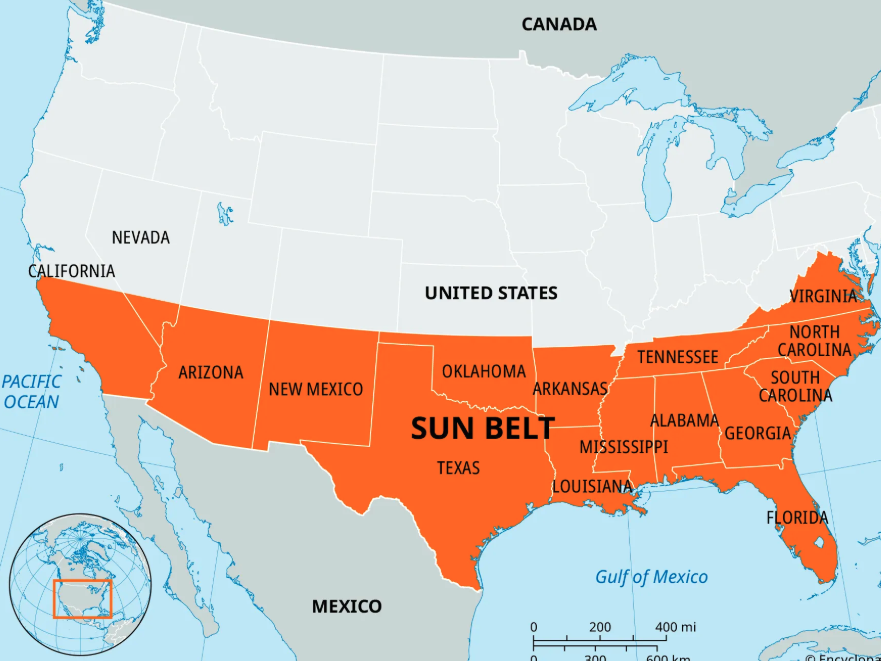
The Sunbelt that lies to the southeast and southwest of the United States is the hottest real estate area across America, figuratively and literally. Previously recognized by a warm climate and cost-effective living conditions, the Sunbelt has turned into the destination of both job seekers, retirees, telecommuters, and investors.
Coupled with booming economy and business friendly policies, such states have turned to gold mines when it comes to real estate. The activity in the growth does not stop as we venture into 2025, it is catapulting.
In this paper, we will discuss the 7 U.S. Sunbelt markets that are going to blow up in real estate development this year and onward, the reason behind this boom and how investors can position themselves to succeed.

Knowing Sunbelt Boom
Sunbelt is a region that is located in the south of the United States that has the states of Florida, Texas, Arizona, North Carolina, South Carolina, Georgia, Tennessee, and Nevada.
The Sunbelt has historically become noticed in the 1970s when there was a migration of businesses and individuals out of the industrial build-to-rust Rust Belt to the areas, which were warmer and cheaper. Trends Hack to present-day, not only has the trend persisted, but it has also increased in strength due to remote work, reduced taxes, affordability, and employment opportunities.
InsurTech 2025: The Top Technology Trends to Watch
Why the Sunbelt Is Booming
Population Growth: There is a migration of millions of Americans to the Sunbelt cities per annum.
Job Opportunities: Technological, logistics, health and financial industries are booming.
Affordable Housing: Sunbelt homes are already affordable as compared to coastal metros.
Tax Breaks: A lot of states (such as Florida and Texas) do not levy state income tax and this is attractive to all the workers and retirees.
Business Climate: Favourable business policies are enticing new businesses and companies moving out.
This has led institutional and individual real estate investors to invest in billions of Sunbelt real estate, the single-family home, to massive multi-family complexes.
Why 2025 States a Breakout Year to the Sunbelt
a. Remote Work Is Here to Stay
After the pandemic, most professionals learned that they could work at any place of their choice, but they are moving to a state with sunshine, space, and reduced living expenses.
Such cities as Austin, Tampa, or Raleigh have become the favorite options of remote workers who want to find the balance in their lifestyles and affordability.
b. Technology Growth outside Silicon Valley
Relocation of the tech companies to Texas, Florida and North Carolina has stimulated job creation and housing demand. Such large corporations as Tesla, Oracle, Apple, and Meta opened large campuses in Sunbelt areas.
c. Institutional Investment Surge
Huge properties like Blackstone, Invitation Homes and Lennar are purchasing and constructing rental houses at a high rate and they are betting on the demand in the long term.
d. Infrastructure Growth
New highways, airports and transit projects that have cost billions of dollars are making previously remote places accessible and investment ready all over the Sunbelt.
The 7 U.S. Sunbelt Markets That Will Expertsly Grow
Austin, Texas – The Tech Capital of the South
Key Drivers
Technology migration: Large enterprises such as Tesla, Apple, and Google have increased their activities in the region.
High Wages: Median household incomes are fewest in Texas.
Population Boom: The Austin metro region is projected to reach more than 3 million inhabitants in 2030.
Startup Culture: An entrepreneurial ecosystem that is flourishing and dynamic brings both entrepreneurs and venture capital.
Real Estate Outlook
Rents and house value remain high as the housing demand exceeds the supply due to the increased prices. The suburbs like Round Rock, Georgetown, and Cedar Park have high potential of investment in single family and multifamily homes.
Tampa Bay, Florida – A Coastal Growth Magnet
Key Drivers
Healthy Job Market: Finance, Healthcare, and logistics developments.
No Income Tax: Florida is a tax-friendly state that is appealing to professionals and retirees.
Infrastructure: Tampa international airport development and residential developments.
Lifestyle Appeal: Beaches, night life, and culture attract residents and tourists.
Real Estate Outlook
The rental market of Tampa is still on fire due to the influx of population into the state by the northern states. Suburban areas such as Wesley Chapel and Riverview are under the attention of the investors due to their affordability and good value of appreciation.
Raleigh-Durham, North Carolina – East Coast Innovation Hub
Key Drivers
Best Universities Duke, UNC, and NC State are a reliable source of talent.
Tech and Biotech Growth: Hundreds of startups and Apple construction of a $1 billion campus jobs.
Living standards: cheap living conditions, good schools.
Population Boom: The metro area is increasing at a rate of almost 100 people in a day.
Real Estate Outlook
The migration is high, with good-paying jobs and a steady inflow of people therefore housing inventory is low. Such suburbs as Cary, Apex, and Holly Springs can be used by long-term investors, who are interested in family rentals or new development.
Phoenix, Arizona – The Desert Giant
Key Drivers
Job Creation: Tech manufacturing plants and semiconductor plants are attracting thousands of jobs.
Climate Migration: The California population is flocking to cheaper house and sunshine.
Infrastructure: Billions of light rail and freeway expansion.
Business-Friendly Taxes: Lure the startups and retirees.
Real Estate Outlook
The population of Phoenix was more than 5 million which made it one of the biggest metros of America. There is a great appreciation and rental demand in such submarkets as Mesa, Chandler, and Queen Creek.
Nashville, Tennessee – Music City Meets Magic of Real Estate
Key Drivers
Corporate Migration: Amazon, Oracle and AllianceBernstein have significant presence.
Tourism & Entertainment: A consistent demand factor of a short-term rental.
None State Income Tax: Favorable to high-income professionals.
Population Growth: 20 percent since 2010.
Real Estate Outlook
Atlanta has one of the highest rental returns in the U.S. and the Alpharetta, Marietta, and Smyrna Submarkets are among the areas where investors are attracted to residential and multifamily investments.
Las Vegas, Nevada – The Resurrection of the Desert
Key Drivers
Technology & Sports Expansion: The expansion of logistical, entertainment, and sports franchises, such as the Raiders and Golden Knights.
Remote Work Magnet: California residents are still leaving to find reduced costs and taxes.
Tourism Recovery: Hospitality and housing thrive amid post-pandemic travel boom.
No State Tax on Income: Good attraction to both professionals and the retirees.
Real Estate Outlook
Vegas market has high rental rates and increased home prices. Developments such as Henderson, Summerlin, are another favorite area among investors when it comes to long term and short term rental.
The Major Investment Strategy 2025
a. Target Emerging Submarkets
Although competition is high in core metros such as Austin or Tampa, outer suburbs can be a better place to live in and appreciate in value.
b. Accept Build-to-Rent (BTR) Opportunities
Single-family rentals are on fire. BTR communities provide more stable cash flow and reduced turnover of tenants.
c. Leverage Short-Term Rentals
The markets based on tourism, such as Nashville, Tampa, and Las Vegas, are the best targets of Airbnb-style rentals, when the local legislation is not prohibitive of it.
d. Partner with Local Experts
Local agents and contractors, as well as property managers, know the trends in the neighborhood and changes in zoning that can either make or break an investment.
e. Monitor Interest rates and Supply
Monitor mortgage trends – a fall in rates in 2025 will trigger another buying frenzy, and any impairment in new construction will restrict supply.
Risks to Consider
No market is without risk. Here’s what to watch:
Climate Risks: There are more cities in the Sunbelt that are exposed to hurricanes or heat.
Increasing Insurance Premises: Particularly on the coast such as Florida.
Overbuilding Concerns: There would be a risk of over-constructing in specific metros.
Affordability Pressure: Expectation of growth can be slackened by an increase in price.
These risks can be overcome by the best investors diversifying their city, and type of property.
Why Sunbelt is in the Favour of Institutional Investors
Billions of dollars are being wagered on the Sunbelt by the major real estate funds and corporations. Why? Because the math makes sense:
High Population Growth = High Housing Demand.
Light Regulation = Less Regulation Construction.
High Rental Yields = Stabilized Cash Flow.
CBRE and Redfin reported that Sunbelt rents increased by 30-40% in 2020-2024, much higher than the national levels. As the rate of job migration and economic growth remains in an upward trend, this trend would continue into 2030.
Prognosis Long-term Future of Sunbelt
Moving forward, the real estate tale of the Sunbelt is yet to come to an end. In the coming ten years, it is foreseen by experts:
- The high-cost coastal areas continued to dump their population.
- More foreign investment in Sunbelt multifamily and industrial real estate.
- Greenscape development of environmentally friendly housing and solar villages.
- Increased land prices as the suburban regions evolve into new urban centres.
In simple terms the new American dream corridor is the Sunbelt – where opportunity is afforded.
FAQs
Q1. What is the Sunbelt region?
The Sunbelt can be defined as those southern states of the U.S. that have hot climates and have great economic growth such as Florida, Texas, Arizona, Georgia, and others.
Q2. Why is the Sunbelt real estate booming?
Due to migration of people, creation of jobs, low taxes and the houses were affordable. All these contribute to the high demand of both renting and owning homes.
Q3. Which Sunbelt cities should you invest in in 2025?
The best ones are Austin, Tampa, Raleigh, Phoenix, Nashville, Atlanta, and Las Vegas.
Q4. Can the Sunbelt boom be sustainable?
Yes, there is the sustained growth in terms of diversification of jobs, investment in infrastructure, and migration tendencies, but local markets are likely to vary.
Q5. The question is how a small investor can be involved.
This can be initiated by renting houses, investing in REITs that deal with Sunbelt real estate, or teaming up with local real estate syndicates.
Q6. What is the best performing property?
Individual family, multifamily apartments and short term vacation rentals are doing well because of the high rental returns.
Q7. Are there any downsides?
Increase of insurance rates, risks of climate and competition are a concern but such risks can be reduced by diversification and research.
Conclusion
The Sunbelt region is redefining the real estate map in America. The flyover country as we used to call it, is the new center of growth, innovations and opportunities.
The Sunbelt has the solution to any investor, whether it is high returns, population growth, and resilient economies of the tech-driven Austin and Raleigh, or lifestyle destinations such as Tampa and Las Vegas.
As 2025 unfolds, one thing is clear:
The Sunbelt is not only shining but it is burning with opportunity.
And regardless of whether you are a seasoned investor or you are new to the game, it is time to look south and grab your own share of the next big real estate story in America.